



Bowing Wall Repair in Wichita: When Clay Soil Pushes Back
Wichita sits on the flat Arkansas River plain, where clay and silt soils over Permian shale swell hard after every spring storm and shrink again in summer drought. That constant wet-dry cycle loads the older brick, stone, and block foundation walls found in College Hill, Riverside, Delano, and Fairmount bungalows, and the result is a wall that leans inward at the top or bulges at mid-height. Bowing Wall Repair in Wichita means stopping that movement with carbon fiber straps, steel I-beams, or wall anchors sized to the severity of the bow and the soil behind the wall. We do not just patch the crack and hope. We read the wall, measure the deflection, and build a repair that fights the same hydrostatic pressure that caused the problem. If your wall is moving, start with a free basement inspection so we can put a level on it and tell you what stage you are in.
Why Bowing Walls Show Up in Wichita's Older Basement Stock
Most of the bowing walls we open up are in 1910s to 1940s brick and block basements, plus the 1950s to 1970s ranches across Linwood, Sunnyside, Haysville, and Derby. Those walls were never designed for the hydrostatic pressure that saturated clay soil delivers. When the water table rises near the Little Arkansas River or a low spot by Chisholm Creek collects runoff, the clay pushes inward and the wall gives at its weakest point. Freeze-thaw cycles each winter widen existing hairline cracks and let more water in.
- You see a horizontal crack running along the middle of a block wall, which is the classic sign of soil pressure rather than settlement.
- The top of the wall leans into the basement more than an inch over eight feet of height.
- White efflorescence powder appears where water pushes through the block and evaporates on the inside face.
- Doors and windows on the main floor stick because the wall movement has racked the frame above it.
- You find previous owners patched the same crack twice, which means the pressure was never relieved.
Any one of these signs is worth a professional look before the movement accelerates.
Key info: A block basement wall in a 1920s Riverside bungalow that bows two inches is not the same job as a poured wall in a 2005 Maize subdivision home that bowed half an inch. The repair method follows the wall type and the measured deflection, not a one-size kit.
For the official word on structural permits and inspection requirements, check the City of Wichita building department pages before any structural repair begins.
How We Stabilize a Bowing Wall in Wichita, Step by Step
We start by figuring out why the wall moved, not just where it cracked. That means checking grading, downspout discharge, the drain tile at the footing, and the soil moisture behind the wall. If the wall is still moving, we relieve the pressure first and then install the structural reinforcement. Skipping that order is how a repair fails in two years.
- We measure the deflection with a level and a string line and photograph the wall so we have a baseline.
- We inspect the footing drain and the interior perimeter drain to see whether water is being managed or just pooling against the wall.
- We recommend carbon fiber straps for a wall that has bowed less than two inches and is not actively moving at the top.
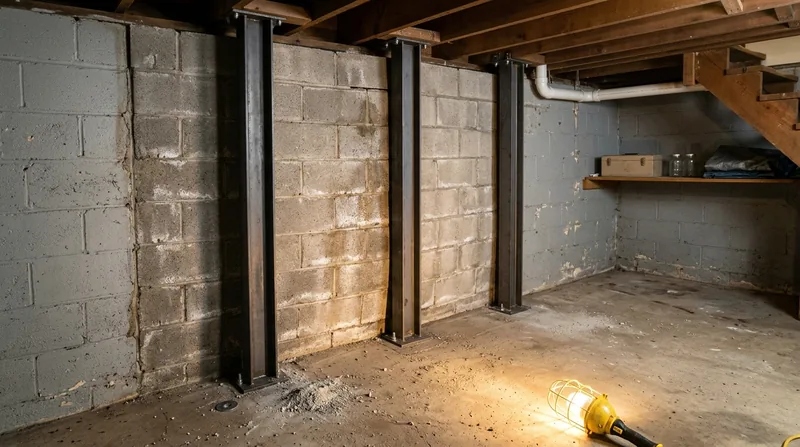
- We install steel I-beams or wall anchors when the bow is deeper, the wall is block, or the top of the wall has kicked inward.
- We address the water source with exterior basement waterproofing or drainage corrections so the pressure does not return.
- We re-check the wall after installation and give you a written record of the deflection before and after.
The right sequence is pressure relief, structural reinforcement, then water management, and that order is what keeps the repair holding through the next wet spring.
Key info: On a 1960s split-level in Haysville, we found a block wall bowing nearly three inches with a failed footing drain feeding it. We installed steel I-beams and corrected the drain before the next storm season, and the wall has held its line since.
Bowing Wall Repair Methods We Use
| Approach | Description | Best for |
|---|---|---|
| Carbon fiber straps | Epoxy-bonded straps run floor to ceiling to stop further inward movement. | Poured walls with a bow under two inches and no top kick-in. |
| Steel I-beams | Vertical beams set against the wall and tied into the floor and footing. | Block walls and deeper bows where straps alone are not enough. |
| Wall anchors | Plates on the inside wall tied to anchors buried in stable soil outside. | Walls that have moved at the top and need to be pulled back. |
| Drainage correction | Repair of footing drain, grading, and downspout discharge to cut pressure. | Any bowing wall where water is still loading the soil behind it. |
| Crack injection | Epoxy or polyurethane injection to seal the crack after the wall is stable. | Sealing the leak once the structural repair is complete. |
Bowing Wall Repair Cost in Wichita: What to Expect
Most bowing wall repairs in the Wichita metro start around $600 for a single strap or a small localized repair, and the price climbs from there with the length of wall involved and the method. A full block wall with multiple steel I-beams or a wall anchor system runs well above that starting figure. The main cost drivers are the length of the bow, whether the wall is block or poured, access to the basement, and whether drainage work is needed to stop the pressure from returning.
Getting two or three estimates is smart because a contractor who only sells straps will quote straps even when the wall needs beams. Ask each one to explain how they measured the deflection and what they are doing about the water. Our full pricing overview lays out the ranges so you can compare bids on the same scope.
Bowing Wall Repair Near Me: How to Vet a Contractor Near Wichita
When you search for bowing wall repair near me, you will get a mix of dedicated waterproofing companies, general foundation firms, and out-of-town outfits. Ask each one for proof of licensing and insurance before they walk your basement, and get the certificate sent to you directly. Check references on jobs done at least two years ago so you can see whether the repair held through a full wet season.
Structural repair usually needs a permit, and the rules vary by jurisdiction, so confirm with your local building department what applies to your address. If your home is in an HOA, check the architectural rules before any exterior work or excavation. When you are ready to talk through your wall, contact us and we will set up a free inspection.
Ask every contractor the same three questions: how did you measure the movement, what method are you using and why, and what are you doing about the water behind the wall. The answers separate a real repair from a cosmetic patch.
Stop the Movement Before the Next Wet Season
A bowing wall does not straighten itself out, and every wet spring in Wichita adds pressure behind it. If you have seen a horizontal crack, a lean at the top, or doors that suddenly stick, call (316) 867-9121 and we will come out, measure the wall, and tell you honestly whether you need structural reinforcement or just crack sealing.
Bowing Wall Repair in Wichita: Pricing Guide
| Service | Price | Details |
|---|---|---|
| Carbon fiber strap repair (single wall section) | Starting at $600 | Covers measurement, strap installation on a short section, and written deflection record. |
| Steel I-beam reinforcement | Starting at $1,800 | Includes beam set, floor and footing tie-in; price rises with wall length and access. |
| Wall anchor system | On estimate | Needs an on-site look at soil conditions and the amount of top movement before quoting. |
| Drainage correction add-on | On estimate | Footing drain repair or grading work priced after the inspection shows where water is loading. |
| Travel | Included | in Wichita and surrounding areas, no separate call-out or mileage fee |
| Estimate | Free | Response within 24h at (316) 867-9121, no obligation to book |
Indicative pricing, the exact cost depends on square footage, finish, and site access. Free personalized estimate within 24h at (316) 867-9121.


